• Skip to main content

Jo Squire Writes

Action Fiction Africa Female

  • Home
  • Jo Squire
  • All Books
  • Travel Blog

admin

PNG Remote Church

February 16, 2020 by admin

As the MV Chertan pulls up at the Kwato Island jetty, a group of curious kids jostle for the best view of our back deck. The deck contains rows of wetsuits and tanks, an underwater camera table, and ten divers from the Nautilus Scuba Club whose chatter is noisier than that of the kids.

The open, innocent faces of the curly mopped kids watch our every movement. Later they dive-bomb off the jetty, a favourite activity for children in remote PNG coastal communities.
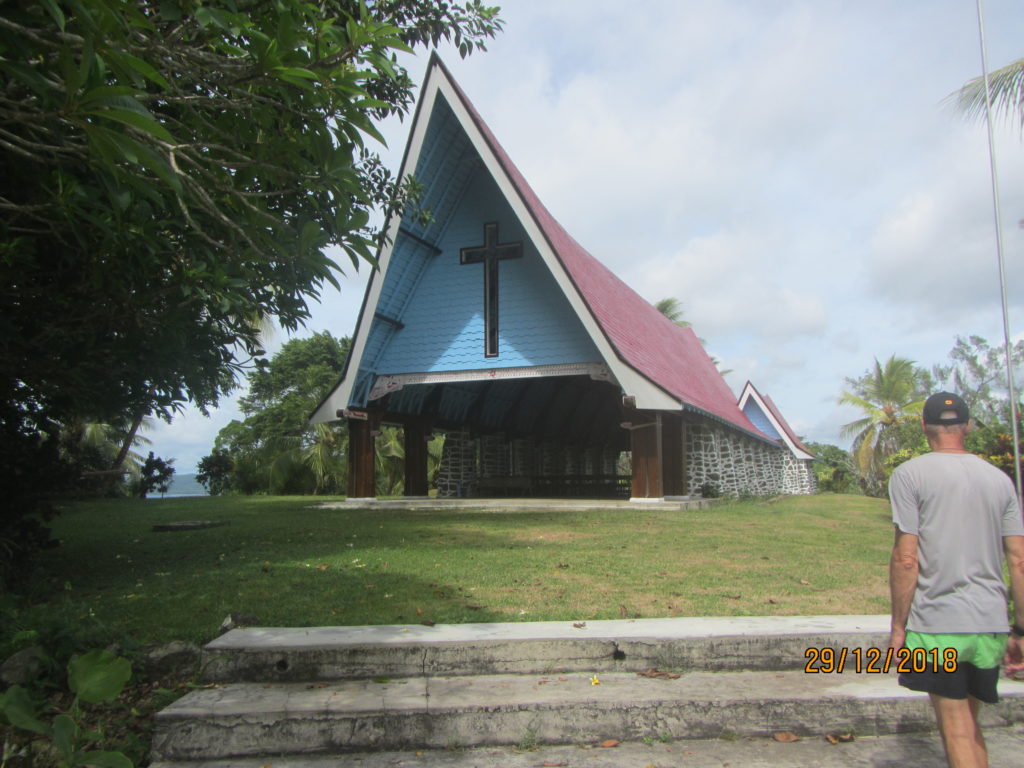
After our first critter filled dive, we tuck into yet another hearty breakfast. To occupy the surface interval between dives, my dive buddy and I take a walk through the small settlement toward the church. Our grassy track ascends between old jacarandas and giant fig trees to a high point overlooking the village. Along the way, we catch glimpses of a sunlit ocean through gaps in the canopy. A five-corner tree and the enormous figs remind me of the vegetation back home in tropical Queensland, but everything seems grander here. So many of our ancient trees have been quietly felled by local councils in Australia, one by one, the not so slow attrition of nature as we hurtle toward our cemented cityscapes. 

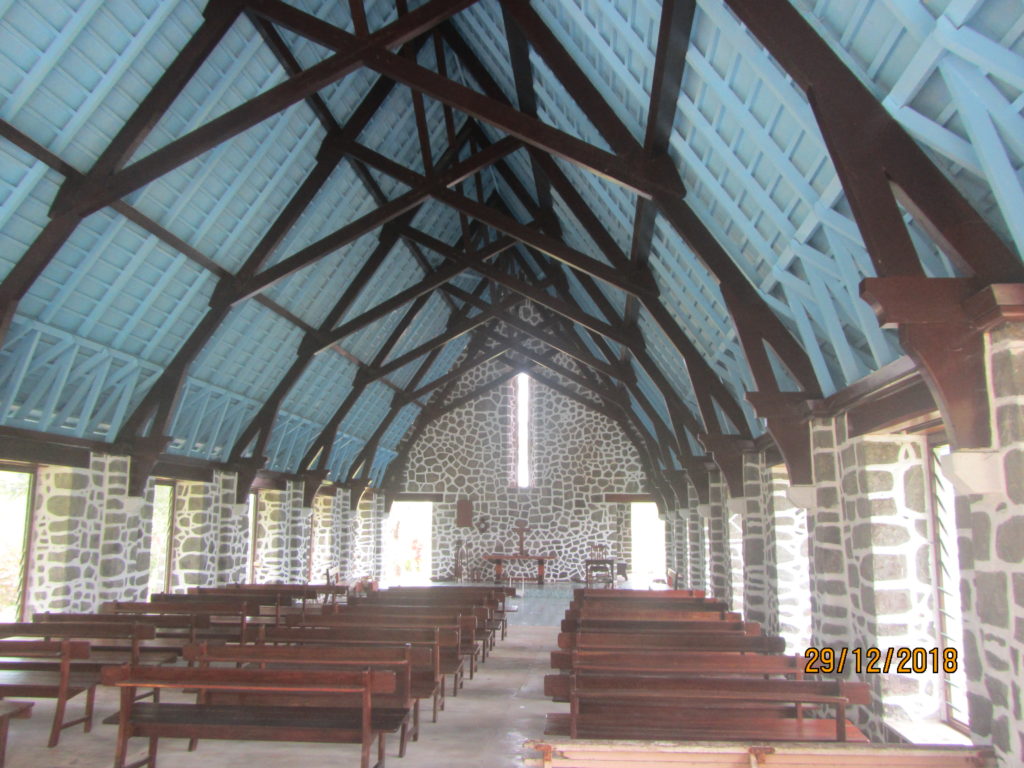
The A framed church looks modern, but the plaque says missionaries built it in 1941.

“They were keen to get this built during the war,” says Pete.

But they did, and it looks as new and polished as it probably was on the day they finished it. Sensibly, the sides are open and partly louvred so that the worshippers can gaze across expansive ocean views and luxuriant forest canopies — a reminder of the beauty laid out by God. Its high blue roof and hand-built stone walls seem at odds with the wooden thatch-roofed houses on the beachfront some way below us, but it’s gorgeous never-the-less.
When we return, the kids have relocated to seats on top of a world-war engine that’s half rusted-away by the waterfront. Old and overtaken by nature, it’s become part of the landscape. Two of the children hold paddles as if they plan to paddle their craft across the deep green ocean only metres away. I wonder if the kids ever swim down to the motor sitting on the seafloor by their jetty, only partly disguised by coral and sponges.

We do another incredible dive, this time under and along from the jetty: ornate ghost pipefish, stonefish, and my first toadfish. Also, a range of cute blennies – from tiny ones with their faces stuck out of holes to fat rockhoppers that munch seaweed off rocks. Naturally, we’re delighted. Akiko gives the dive two stars, her highest rating. Heaps of other stuff too, and so many critters we lose track. It would take all day to try and classify them all.
Filed Under: Diving, Uncategorized Tagged With: #environment #conservation #author #novel #elephants

Where is Fakarava Atoll?

June 9, 2019 by admin

Our research group splits today, one group to count birds on the atoll rim, and the other on an island within the lagoon. I’m in the latter group of lowlier researchers, who score the less exciting jobs. After a month of bird counts in the Tuamoto Islands of French Polynesia, our group is nicely zoned-out and not in a hurry. I’m in the habit of snorkelling between counts. The moment they’re done, I hit the water, where the visibility is fantastic. Today, I decide to snorkel alone ahead of my group across to the rainforest-clad island that’s reasonably close to where we’re anchored.

The sky is blue, and rays of light twist and turn through the water below me as I set off. Even through the crystal-clear water, I can’t begin to see the bottom. Swirling light beams vanish into deep black down there. For a while, I’m fine with this, but the swim is long enough for anxieties to surface. I begin to wonder about what might lurk in the depths. As a diver, who regularly sees sharks, I’m supposedly not so easily spooked. But it’s lonely out here and the dingy to bring my workmates across, still waits empty by the rusty boat that’s our temporary home. I tell myself not to be wimpy, a habit left-over from the days of my mother telling me not to be so stupid. And I continue, partly because I’m almost halfway across, so it’s now as risky to bail out as to continue to the island.

At last, a sandy slope emerges from the gloom below, and I’m less worried about being a target for a shark attack from below. At least I’ll be able to see danger now, unless it comes from behind as it usually does! In the shallower water, I slow and search for fish and turtles along the shoreline. It’s then I see fins twirling out toward the end of the island. My gut lurches and I swim quickly toward the shore, not splashing the water too much, to avoid unwanted attention.

My heart is pounding when I stop in 4 foot of water, and crouch under the surface to look out to where dangers lies. And I understand it’s all in my mind again. There’s a manta ray swimming loops out there as it filters plankton, its wings masquerading as shark fins. Now my chest is tight from excitement rather fear, as I push off from the bottom and swim hard toward the manta. It’s not alone!

For twenty minutes, I have 3 mantas all to myself as they swirl around in the shallows. I can hardly believe my luck. My colleagues arrive in the dingy and immediately flop over its edge into the water. They saw mantas from the surface on their way over. All thoughts of the bird count gone, we spend another surreal hour in the water while the mantas fly circles around us, so close we can almost touch them.

Filed Under: Diving, Uncategorized Tagged With: Tuamoto Polynesia Diving Manta rays sharks

Muck Dives

April 9, 2019 by admin

For those of you not yet initiated, muck diving involves swimming exceptionally slowly along the ocean floor. Spectacular fans, gorgeous corals and brightly coloured fish are not an integral part of the scenery.

Having said that, our muck dive at Lawadi, North Milne Bay this morning ended with a long swim back around an underwater headland over acres of pristine coral, as the boat was parked on Deakins Reef around the corner.

The first half hour was a familiar Muck Dive, a brown rubble-strewn slope, apparently devoid of life. That’s until my focus came down to the really small stuff. Not far along the slope, Alex is shouting underwater, not an easy feat, but he practises a lot and is an expert. Several divers respond instantly and swim toward the nondescript patch of slope in front of his large camera. With a metal pointer, he indicates a minuscule dot in the mud, our first nudibranch. With my brand-new bifocal mask, I can actually see it for once. I make a mental note to ask to see the massively enlarged image on his computer screen later, so I can truly appreciate what I saw.

One by one the divers disperse away from the nudibranch. We spread ourselves out, so five of us hang parallel to the slope, faces a few cms above the rubble. Alex is the nearest to me, his wetsuit encompassing a hood, giving him the appearance of being in underwater stealth mode. His country of birth gives us leeway to rib him about being a Russian spy.

We are lucky enough to eventually discover a seahorse, drifting across the slope, moving like a piece of floating debris, so as to not draw attention to itself, a common ploy of critters found in muck sites. After a while, as often happens on these dives, I spot dead leaves mimicking leafy scorpionfish, halameda seaweed posing as halameda ghost pipefish and numerous other shapes protruding from the slope pretending to be something interesting.

To break such excitement, I’m lucky enough to discover a mimic octopus on the hunt. I watch it sitting on the spot with the ends of its tentacles probing invisible channels in the sand. It moves along a few cms and tries again, its body rearranged into the head and a surrounding shirt. This octopus when threatened will flee, its tentacles re-shaped to resemble a flounder.

The muck dive deteriorates into pristine reef for the swim back, though the water is murky from run-off and the visibility is poor. The reef scenery unfolds, emerging out of the inky water, like mountain scenery on a misty day. I’m not joking when I say – it’s stunning.   

Filed Under: Uncategorized Tagged With: #environment #conservation #author #novel #elephants

Boat Vendors

March 2, 2019 by admin

Boat vendors often peddle their wares on lakes or rivers in busy places. Bangkok floating markets for instance, or in Srinagar, Kashmir, where I stayed on Dal Lake in an old-style houseboat for a week. Our boat came with traditionally carved furniture and Indian rugs. It was 1989 and we got a special deal because the unrest in Kashmir had scared sensible tourists away. We were too young to know better and survived our stupidity splendidly.  Local visitors paddled their boats over, loaded with food or local art, and we’d hang over the railings and bargain our hardest.   

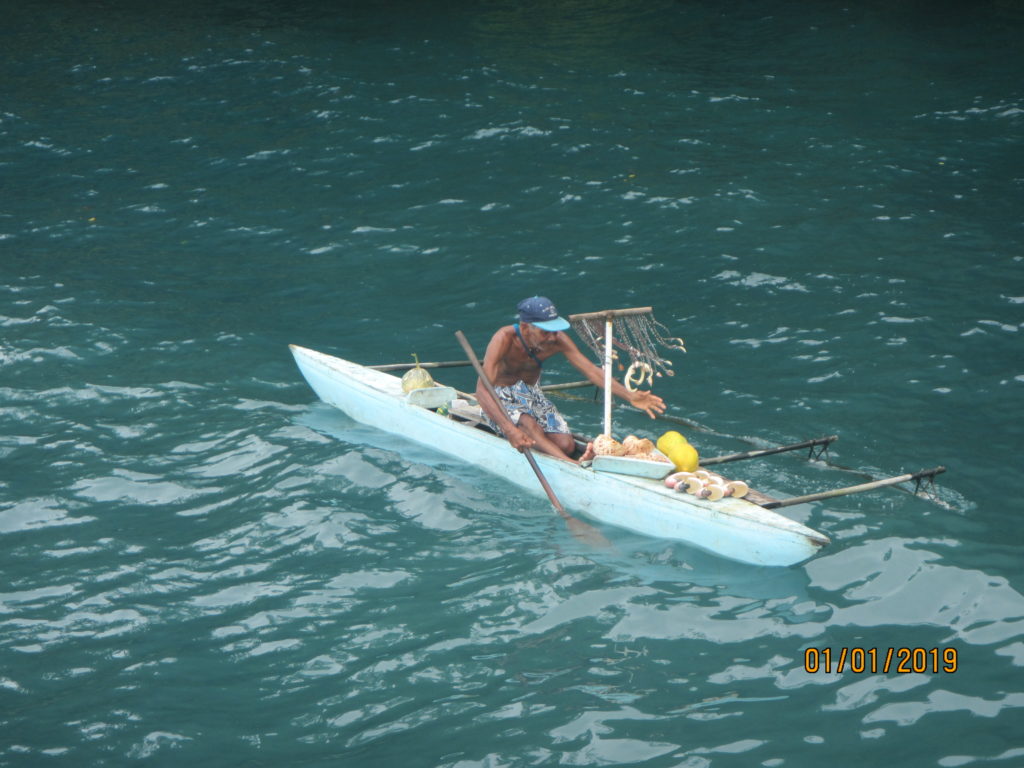
Because of the apparent remoteness of many PNG dive sites, I never expected to see so many similar boats paddled across to us. Their industrious owners were determined to make contact. Sometimes they’re just curious villagers from near-by islands. But there are vendors almost everywhere the MV Chertan pulls up anywhere near to land, and occasionally way out to sea.

Before the first dive, there rarely a person in sight, just miles of rainforest clad coastline down to shoreline.  The location seems amazing and remote, a true wilderness perhaps. An hour or so later, as we swim back along the underside of the boat to the ladder, there are wooden canoe undersides, babies to the MV Chertan, huddled behind the dive deck. Paddles dip below the surface as they jostle for position and silhouettes of people lean over to watch us on our safety stop.

Anyone nearby with anything to sell has mobilised. An old man with jewellery arranged across a wooden railing and nautilus shells grins as I surface next to him. His untraditional cap says BOY. Bobbing a couple of metres behind him are 2 kids, possibly brother and younger sister with only their curiosity on board. Later when I’m dry and dressed, the old man is still waiting, his goods perfectly balanced considering the swell. It’s hard to believe they haven’t slid into the ocean. He gives me a thumbs up and I do the same, but he has nothing I want to buy.  

The MV Chertan has parked at Michelle’s dive site for the first time in ages, and she’s casually tied up to a tree. There’s been a fight between a couple of local tribes over who really owns this beach. For a while, both tribes demanded money to anchor here. A man, dressed in shorts and stand-out, bright yellow shirt gesticulates wildly at our canoe vendors. I wish I understood their sign language, as then I’d know whether he’s saying – this is our territory, leave before I cut your head off, or – hey grand-dad, I’ve not seen you for ages and you just missed New Years celebrations.

Filed Under: Uncategorized Tagged With: #environment #conservation #author #novel #elephants

Alaskan Inland Passage

February 20, 2019 by admin

Around me, tired, grumpy people fill the ferry terminal, and my enthusiasm is waning, though I’ve wanted to make this trip for ages. The ferry from Juneau to Bellingham is delayed until midday. The man next to me has been here half the night, and I could have slept in rather than leave my comfy bed before daylight. I’ve just visited my friend Stephanie, who lives in Juneau on the Alaskan coast, a place that suits her free spirit. She hikes and canoes, and regularly goes on cycling trips that may last for 2 months. I’m inadequate in comparison, and I feel guilty she woke up unnecessarily early to give me a lift.

On Stephanie’s advice, I’ve not taken a room on the ferry. Not only will I save money, but also the best view is from the solarium on the top deck. All I need to do is to find my way there, select a deckchair and set up my outdoor bed. I’ve just been on a hiking trip and have my sleeping mat and bag. I’m allowed to erect my tent just outside the solarium on the top deck should the weather pack up or if I decide I need more privacy.

After the initial delay, the 3-day, 3-night trip goes smoothly, with shorter stops at several small Alaskan towns. There’s a canteen and my left-over hiking rations as back-up. The showers and theatre are downstairs. Though for people who’ve not made this trip before, a movie seems a poor substitute for the gorgeous scenery – perhaps at other times of year when the daylight doesn’t last so long.

As well as snow-capped mountains and craggy peaks, I glimpse a black bear crossing a pebbly beach on my first day. The lush forest covered slopes are a constant, though the mountains shrink from windswept giants to rolling hillslopes as the days pass. The passage narrows further south and the forest comes closer. Humpbacks spout into the cold air, their rounded backs breaking the calm surface. A day later the whales are breaching, and I watch through binoculars, grateful for such a treat.

I could sit on my chair for days. I read a little and write a lot, the scenery unfolding all around me. The wild landscape is a constant and the other passengers are friendly. A couple with their two young kids join us in the solarium for the last section of the ride. No-one is noisy at night, and I’m toasty warm under the lamps. Two hikers cook up their own food on a camping stove.  Another couple relocating from Alaska’s cold climate to Arizona’s sun have both their cars on the bottom deck. I jump at their offer of a lift to Seattle as my original plan was to find my way to Bellingham bus station and wait there for several hours.

I’d do it again in a heartbeat, though a flight would be cheaper and take a fraction of the time.

Filed Under: Uncategorized Tagged With: #author, #conservation, #elephants, #environment, #novel

Diving with Pete

February 17, 2019 by admin

I’m incredibly grateful to Pete, my reliable and fantastic dive buddy for 15 years. He can be militant at times, as I can be, especially when we’re keen to get into the water.

“Get a move on, it’s not as if we have all day,” one of us will say, knowing perfectly well that we do. That’s one of many upsides of diving holidays, you do usually have all day to dive, and if, you’re really keen there’s the option of a night dive as well. Neither Pete nor I are keen on night dives, which would make many categorise us as not hard-core. Even when the water temperature is 29 degrees centigrade, it still seems cold and dark, and therefore a horribly miserable idea to struggle into wet gear at night.

Five weeks before a dive trip to Bali, Pete broke his leg. Not one to be discouraged, he insisted it was business as usual. Each morning he took his crutches right to the water’s edge where the rustic Indonesian boat waited for us. Despite my concerns, all went well. Pete and his wife, Merilyn, visited me just before this trip, and he managed to trip up my steps, landing with arms, legs and crutches sticking out at strange angles ahead of us.

“I did ask him how I’m supposed to help when the waves smash against the boat at the dive-site,” I say to Merilyn as Pete struggles to right himself.

“Just put your hand on his head and hold him under for a very long time!” replies Merilyn, her sharp wit instantly in play.

I wouldn’t have made nearly as many dive trips without the familiar phone calls that start off along the lines of: Have you read such and such an article on a dive destination; google it and I’ll call you tonight to discuss. The best piece was about diving with whale sharks in Irian Jaya. The magazine made it look amazing, and the reality was even better. Which makes me eternally grateful to have an instigator for such trips.

We can both be grumpy, but because we’re not a couple, we sort of respect each other and don’t argue as partners are inclined to do. So, the trips generally go smoothly and without drama and upset. It works really well, and we’re able to squabble like an old married couple without either one taking it too personally.

Pete saved my skin when I ran out of air at 30 metres, my own fault for failing to check my gauge. The Indonesian boatmen had forgotten to fill my tank for the dive. I exhausted the reserve twenty minutes into the dive, and as I took the next breath was alarmed to find my supposedly new tank empty. Luckily, Pete was close as we were converged on a leafy scorpionfish pointed out to us by another diver. I grabbed Pete’s arm, gave him an out-of-air signal and indicated I’d do an emergency ascent. My main thought should have been – my god I could die. It was in fact – my god, my sinuses will explode on the way up.

Pete expressed complete disbelief until I showed him air gauge with the needle at the bottom of the red. No need for panic – like a well-trained dive-master, Pete grabbed his mouthpiece and shoved it at me, and then retrieved his octopus-piece for himself. We completed the dive, arm in arm to keep close so I could breathe his air supply, and because we’re both economical on air, had almost as long a dive as everyone else.  When we surfaced, he told me that If I wanted to hold hands, I only had to ask!

Filed Under: Diving Tagged With: #environment #conservation #author #novel #elephants

  • « Go to Previous Page
  • Page 1
  • Page 2
  • Page 3
  • Page 4
  • Page 5
  • Go to Next Page »

Copyright © 2026 · Author Pro on Genesis Framework · WordPress · Log in