• Skip to main content

Jo Squire Writes

Action Fiction Africa Female

  • Home
  • Jo Squire
  • All Books
  • Travel Blog

admin

Rum Runner @ Bougainville Reef

January 30, 2021 by admin

For 16 hours overnight, the Rum Runner has chugged Northward up the coast from Cairns. As always, her skipper works around the Coral Sea’s changeable winds and currents with ease, and Richard has again positioned his boat for another great dive. A few of us were surprised our trip went ahead, considering the edge of a cyclone has only just passed over this stretch of the Great Barrier Reef. However, the water is already crystal clear as we jump from the deck and sink below the Rum Runner.

Pete and I descend gradually toward where the ocean floor meets the bottom of Bougainville Reef 30M below the surface. On such days, when clear visibility extends both ways along spectacular coral walls inhabited by shoals of fish, the experience is almost impossible to match. Brightly-patterned fish dart between corals shaped like stag-horns, plates, and curled wood shavings. Further out are the heavier cautious reef giants, including a school of hump-headed parrotfish.

We fin up-current and reach a point where its strength forces us to hang onto the wall to avoid being swept backward. There are seven large Napoleon wrasses up ahead, more than I’ve ever seen in one place. They hang effortlessly in the current along with a group of white-tipped reef sharks that peel off the slip-stream current and glide curiously past us like friendly pet dogs.
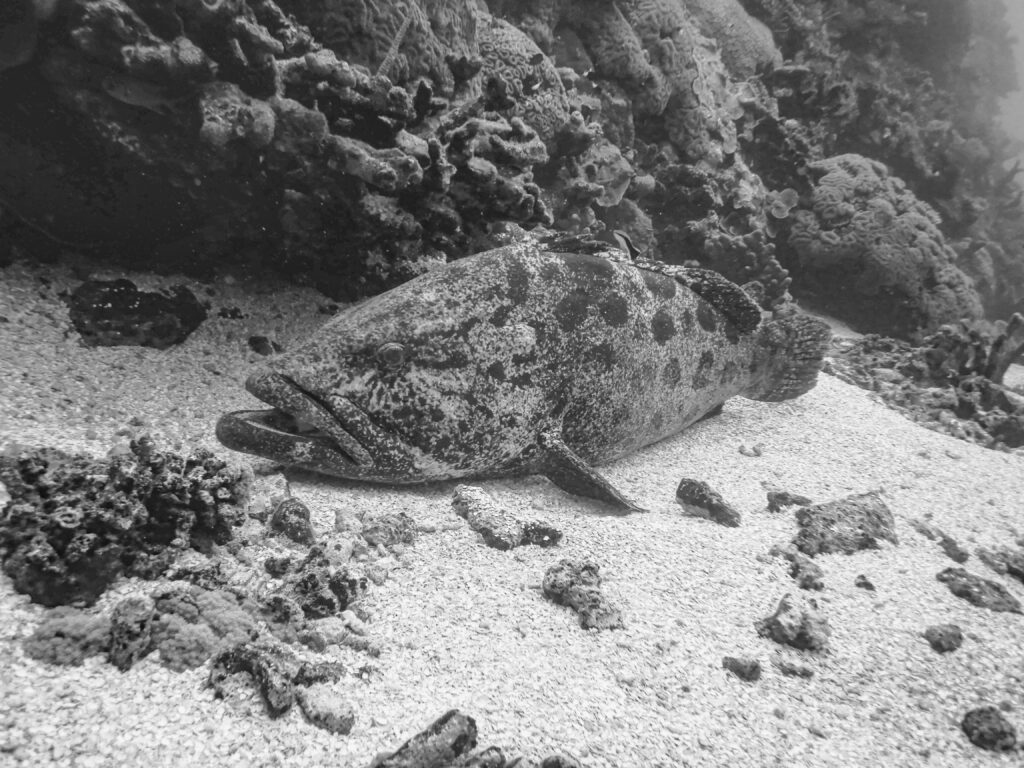
I’m so captivated by my view of the giant wrasses in the current that Pete has to tug on my fin to draw my attention to a massive potato cod. She’s resting on the sand further out on the bottom of the channel. Thrilled, we make animated hand gestures at each other and descend as if parachuting. Careful not to disturb her, I approach from the side. The grouper is unbelievably tame and allows me to swim past her tail and position myself for a photo.

When our dwindling air supply forces us up toward our safety stop, we let the current take us and drift past schools of spotted trevally and blue fusiliers. If only there were more time to take in all the life around us and enjoy the way the ethereal light shafts down from the surface across the surreal underwater scenery.

After an hour out of the water to de-gas, we’re eager to return. This time we head straight toward the area of slip-stream current where the big fish like to hang out. Our reward is a wide cylinder of striped barracuda. We hold our breath to avoid creating bubbles and swim below and then up into the centre of the swirl so that the barracuda’s stretched silvery forms are all around us.
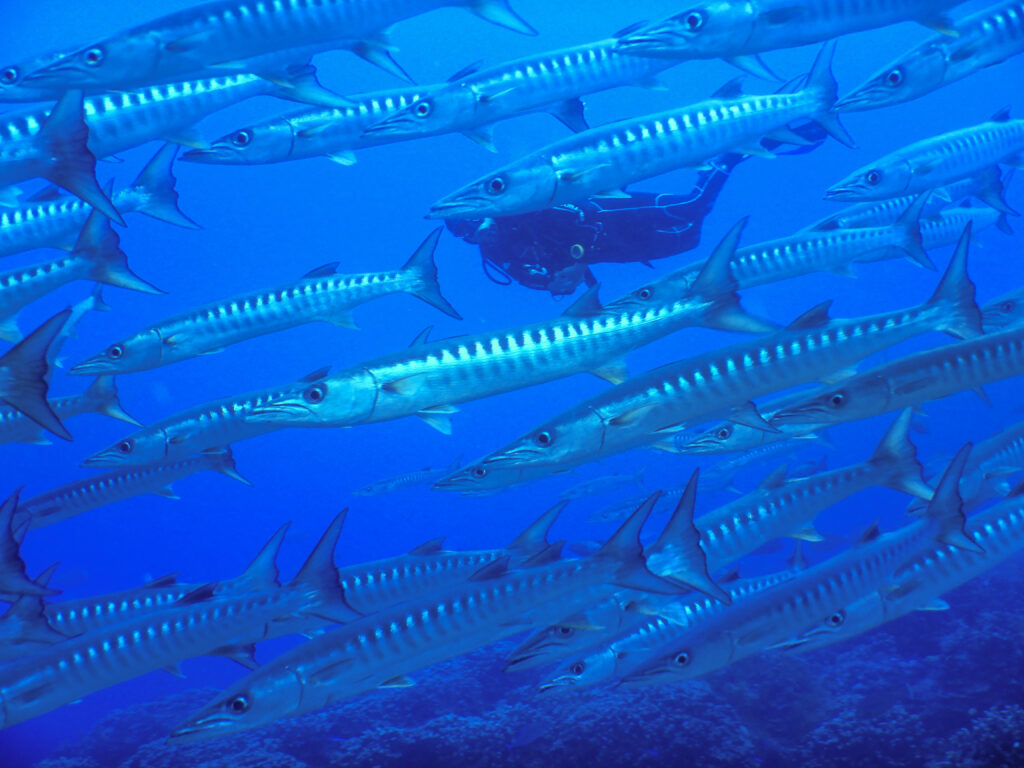
Later as we munch hungrily on a spread of salads and delicious lasagne with the other divers, a glassed-out ocean encircles us, the view not at all what we’d expected after a cyclone. I guess Richard knew best after all.
Filed Under: Diving, Uncategorized Tagged With: #environment # conservation #elephants #novel #author

Goabadubadu, PNG

January 2, 2021 by admin

Google calls this island Badubadu, but I guess the local people know its unabridged name. There’s a manta cleaning station about 50M off the shore of Goabadubadu, which sits in 10M of water.

After a slow chug through the heavy swell of Milne Bay, we arrive around 6.30 am on a misty morning. The grey sky meets the grey ocean with only whitecaps to break the monotony. Despite this, we are eternal optimists and gear up in the rain, enthusiastic about a possible glimpse of frequently elusive manta rays.

“Mantas like weather like this,” my dive buddy Pete chirps up cheerfully, “They always come out in the rain.”

“Sure,” I reply. “I’ve waited enough times for mantas to show up on Manta Dives to know all about that!”

After half a night with our dive boat punching through the waves, I’ve not slept well, and the 2 cups of coffee have not yet kicked in.

Even so, I encourage my tardy buddy to hurry. 

“I’ll wait for you down there!” I shout as I jump in ahead of him and sink below the turbulent surface layers.

Part of me lives in eternal hope, and I’m keen to see a few mantas glide by like sci-fi spacecraft. Actually, on previous dives, I’ve not been entirely deprived and have swum with mantas swirling around me the entire time. They’ve flown past in formation, doing loop-the-loops, and come so low over my head that I’ve ducked despite my appreciation of how incredibly aware they are and knowing that they would not hit me.

The moment I start to sink deeper into calmer water, I relax, always grateful for the experience: the cocoon of water, the sound of my breaths, and an ocean full of life to discover. Mantas or no mantas, there’s always plenty to see, even on the flattest desert-like parts of the ocean floor.

This floor today is sandy, with an occasional coral bommie and an accompanying collection of fish. We make our way across the sand toward the manta cleaning station, with a short stop to watch the tiniest mantis shrimp I’ve ever seen.   At least I’ve seen something with a manta in its name, I think, already prepared for, needless to say, the failure of the real ones to turn up. We hang around the manta cleaning bommie for a while, but none are keen for a de-parasite session, and the cleaner fish focus their efforts on the less spectacular fish.

The highlight of the dive is the most beautiful flounder, beautifully camouflaged against the coarse sand. On its back are three face-like circles, complete with chocolate eye dots and pale nose swirls. As we examine the flatfish, it lifts its head slightly off the sand, ready to flee, its eyes raised within a darker patch of skin, swivelling to ascertain the danger. It edges away on multiple tiny fingers. We back off, not wanting to create further disturbance and leave it to its watery domain. 

Filed Under: Diving, Uncategorized Tagged With: #environment # conservation #elephants #novel #author

Frazer Island Great Hike

October 25, 2020 by admin

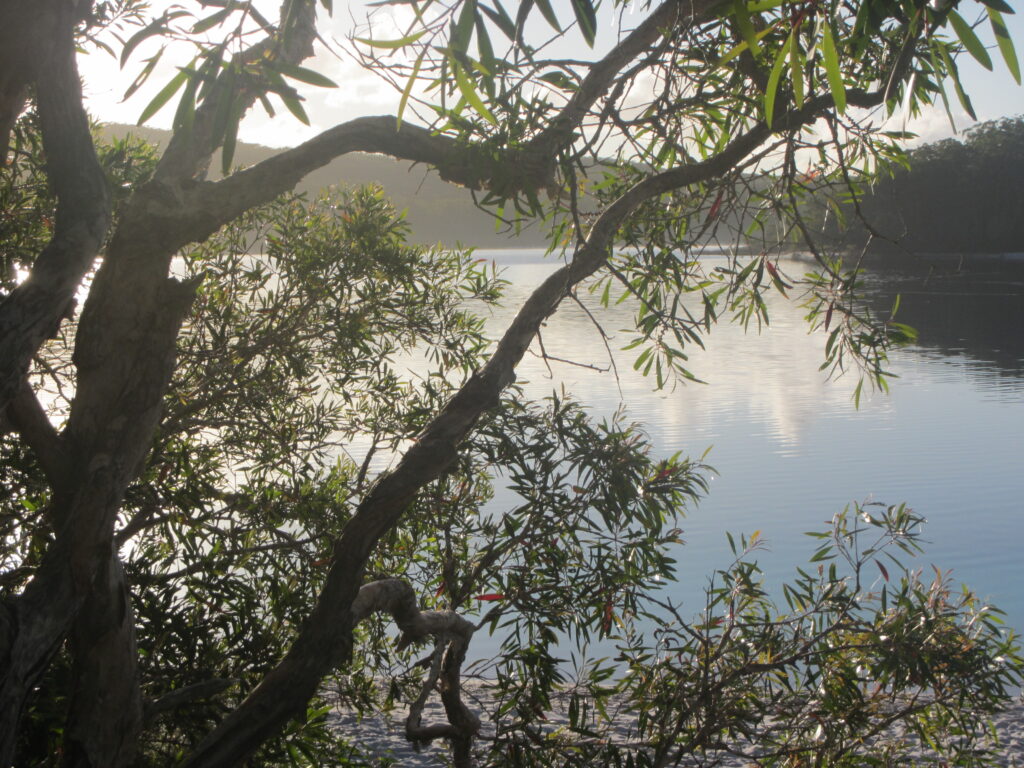
Grey clouds hang over Frazer Island, unleashing mini tornados of rain. The outlook ahead puts a damper on our high spirits as we watch from the ferry on our way to Kingfisher Bay. The scenery bears little resemblance to the sun-drenched, whale-inhabited paradise I’d envisaged when planning our 6-day hike.

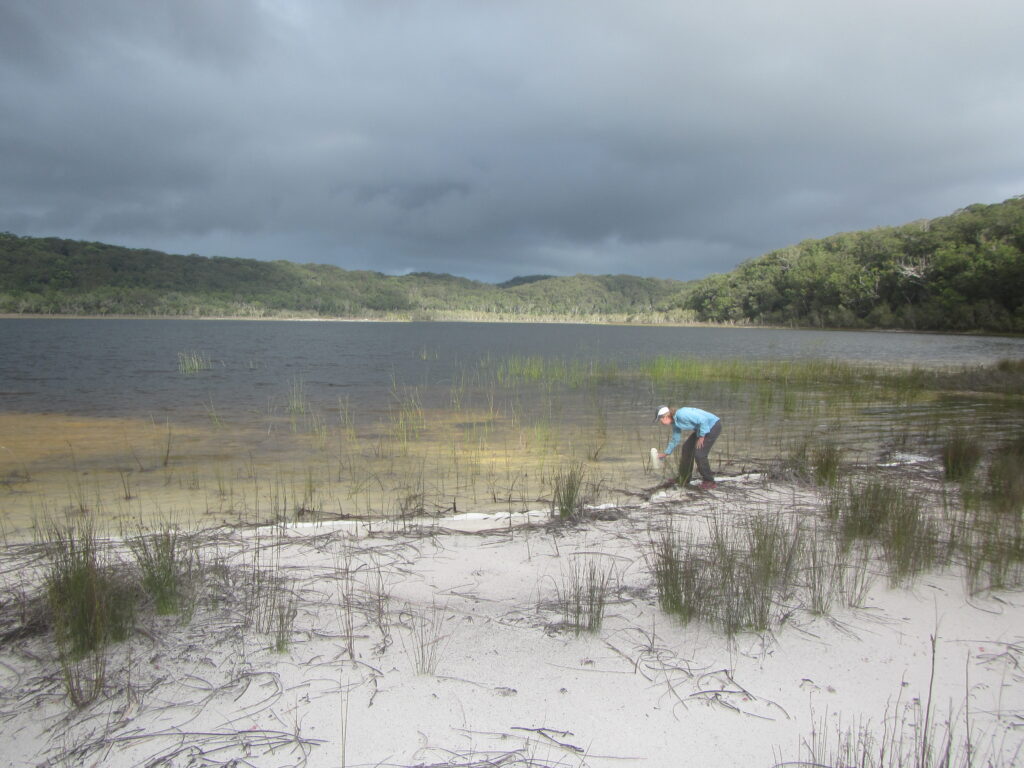
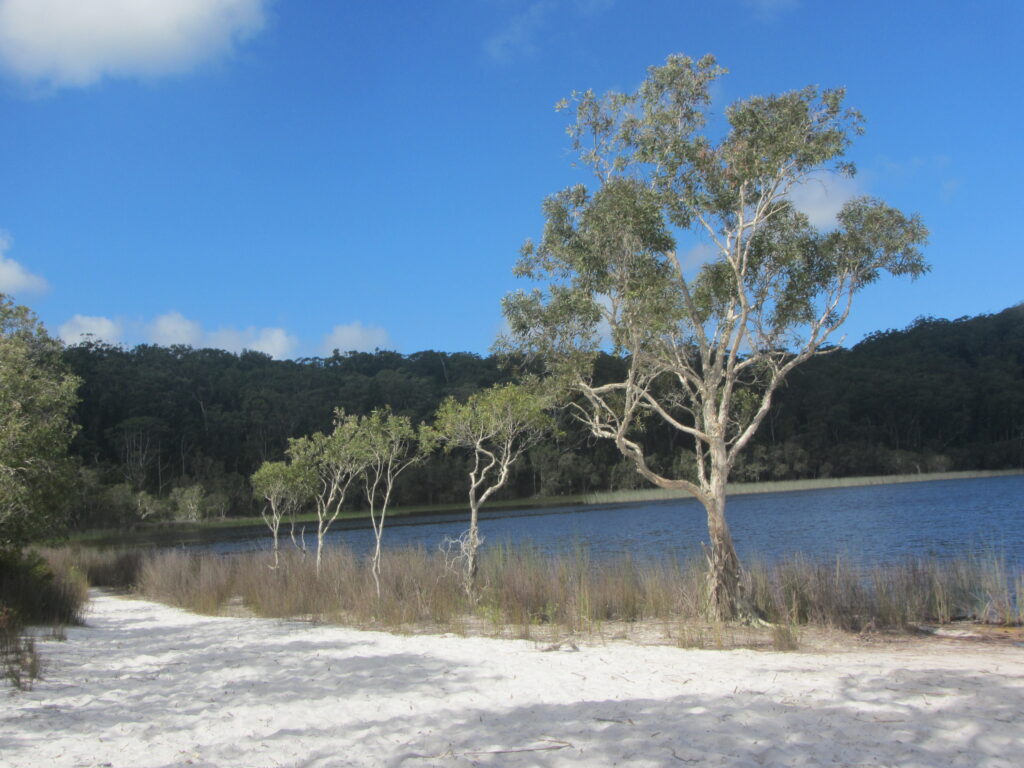
Our walk will take us past a chain of lakes running along the backbone of this 120 km long island north of Brisbane. Although best known for its long sandy beaches and pristine lakes, Frazer Island is predominantly covered with luxuriant rainforest. It’s an hour’s drive to the start of the walk. We pass through the central forest and then along the wide beach along the eastern edge of the island.  This seaward side seems especially wild and spectacular. Swathes of light penetrate the clouds and fall across the rough seas in ethereal hues of emerald and gold. 

Our 4-wheel taxi-driver, Steven, cheerily tells us that last week’s hikers came out looking like drowned rats, as he drops us by the sandy roadside at the start of the hike. We walk past acres of saplings springing up under the burnt skeletons of lost trees. A year ago, forest fires caused the island to be closed for a while.

As we cross the end of our first lake, a rain squall looms on the far bank. It closes in and drenches us. We leap-frog over rivulets draining into the lake until our feet are soaked. When defeated by their increasing size, we surrender to the elements and tromp through gullies of shin-deep water. But apart from this and a downpour on our first night, we stay dry for the rest of the hike. You win some; you lose some. We’ve had our share of being drowned rats in the past.

Most days we swim in one of the crystal-clear lakes that the path leads us past. Between swims, we hoist 20 kg packs through ever-changing forest. In the early stages, we joke that we should sit down and eat all our food to lighten the load. It’s been a while since we did a hike and neither of us has done any training to get fit for this.

Kookaburras wake us up early every morning, and as we hike, we hear them laughing in the distance.  I catch glimpses of red-tailed black cockatoos and a couple of king parrots flitting through high branches. Over our heads, giant trees reach toward the sky, and in their shadows, lush ferns and palms populate the leafy forest floor.

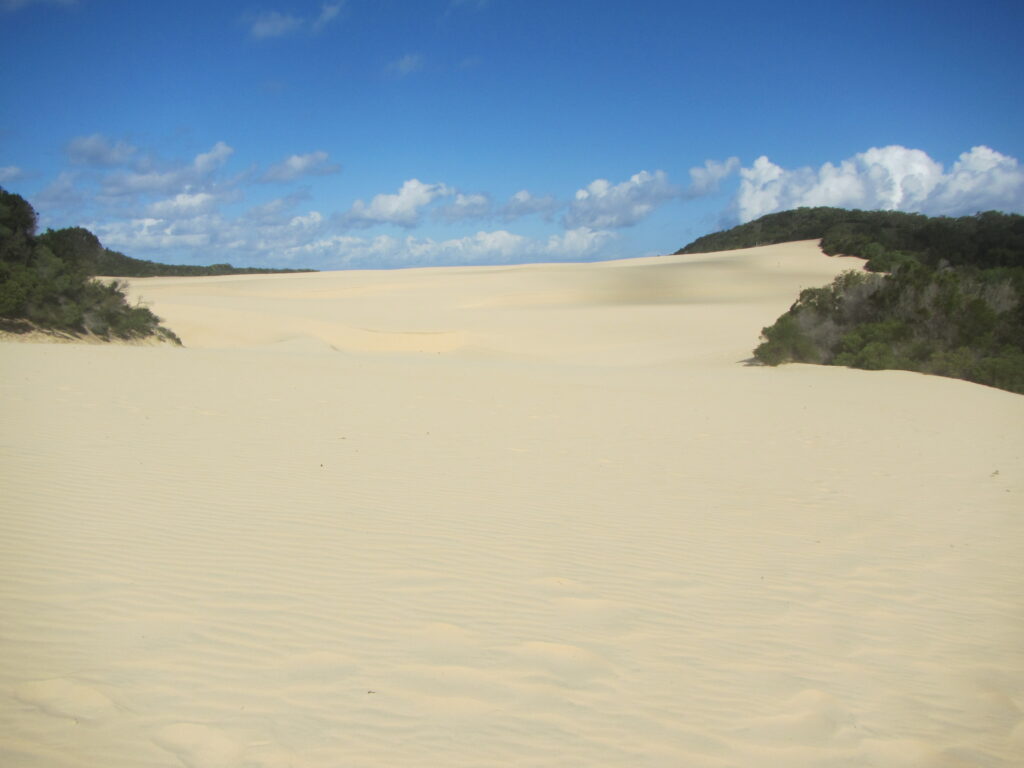
Our best sea-views are from viewpoints over Frazer Island’s famous sandblows. Trapped at the bottom of the stunning Hammerstone blow are the olive-green waters of Lake Wabby that are unfortunately being eaten slowly by the migrating dunes. We follow the forest trail down through the forest and onto the dunes. The lake water is refreshingly cold and patrolled by huge catfish.

A couple of days later, our hike ends at Happy valley, where 4-wheel drives congregate and patrol. We are sad to have left the peaceful wilderness behind.

Filed Under: Hiking, Uncategorized Tagged With: #environment # conservation #elephants #novel #author

Stray dog Banjo

February 16, 2020 by admin

Fortunately, most people are kind-hearted – particularly in areas where hungry stray dogs roam in need of food and attention. Over the years, I’ve seen countless dogs rescued by kind people who can’t stand such neglect of our animal friends. The dogs I’ve saved myself have become amazing and interactive pets. Their hard start seems to make them grateful for any kindness.

Sometimes dogs have several rescuers as friendly dogs scrounge food and attention however they can. On one of my vet trips to Thursday Island, the staff at the Jardine hotel tell me of a stray dog with bite wounds that they’ve developed a soft spot for. The new receptionists thinks he should be put down, her take being – you’ve got to be cruel to be kind. The others are horrified at the idea, as “Banjo” seems perfectly happy though his open wounds are a bit of a mess.

I encourage them to bring him into my clinic for a free treatment. Right now, he’s no-where to be seen. Without more information, I can’t volunteer much advice, and I’ve decided to keep out of their argument for the time being.

The next day Banjo arrives with two women from the hotel. He’s a muscular mastiff cross and ecstatic at all the extra attention. His tail wags energetically as he tears up the steps of the donga that serves as my vet clinic.

Actually, the wound looks worse than it is and has already started to heal. Banjo, like many of the strays, is tough and it’s hardly infected. I give him a penicillin injection, some antibiotic tablets and a shot of parasite control. He takes it like an old hand, without complaint. All attention is good as far as he’s concerned.

I’m busy as always, and Banjo is one of many patients, so I forget him in all the rush. However, the next day, as I walk to work along the mango tree-lined main street of Thursday Island, he appears next to me and follows for a few minutes. A couple of guard dogs chase him off, and he diverts back down the main street. A car screeches to a halt as Banjo crosses and then he heads off after some kids who are going the other way. I reflect that his wounds are not surprising. They also seem have upset everyone but him.

Later that afternoon, one of my regular clients arrives at my vet donga with Banjo on a lead.

“Hi Jo!” she says. “This is not my dog, but I’m happy to pay for whatever medication he needs.” I grin and tell her he’s already been taken care of, but suggest we should organise a home for him. The whole Banjo thing has helped me feel hope for our poor strays.

Filed Under: A Vet's Life. Tagged With: Rescue dogs, Stray dog, Vet

Nelson’s Tongue

February 16, 2020 by admin

“Hi Jo, Can I book Nelson in for a dental please.”  Joan’s voice is familiar. She’s a regular and an excellent cat mother.

“Sure. Does Nelson have tartar on his teeth?”

I know her well enough to expect she’s already pulled back Nelson’s lips to check his mouth.

I can see Nelson in my mind’s eye – a big fluffy moggie with broad tabby markings and huge green eyes. Joan and Rob love all 3 of their cats, but Nelson is their pride and joy.

“He’s salivating and a bit off his food which is most unusual for him! He sleeps with us, and his breath stinks!”  Joan’s comment makes me smile – not at the state of Nelson’s teeth but at the vision of him sleeping, all fluffed up. He probably uses up a decent chunk of her pillow.

Two days later, our vet nurse and I comment on what a lovely healthy beast he is as he calmly regards us through green sedated eyes. After his intravenous anesthetic, I attempt to insert an endotracheal tube to maintain him on isoflurane anesthetic gas.

It isn’t straightforward to pull his tongue out, and suddenly there’s blood in his mouth.

“Where’s it coming from?” Janelle asks.

“Not sure. Maybe he’s bitten his tongue,” I reply and turn it over to check the underside.

An extensive deep tumor runs along the bottom of Nelson’s tongue. My heart sinks as I check how far back it extends.  It disappears into the base where the tongue emerges from his throat. I can see from the way the growth is un-encapsulated that it’s a nasty one. Most likely, it’s spread to the submandibular lymph nodes, which sit a bit further back. We need to check what sort of cells make the mass but it’s doesn’t look good.

The owner of the clinic where I do my surgery is experienced at a range of things, including pathology. Dot inserts a needle to suck cells out of the mass while I expose the tongue’s underside.  We put Nelson’s face into a mask to deliver isoflurane to keep him under and wait for Dot to stain up the cells on her slide.

I shake my head in dismay at Janelle.

“How am I going to break this to Joan. It will be the last thing she imagined!”

I leave Janelle with Nelson and peer over Dot’s shoulder while she stares down the microscope.

“A squamous cell carcinoma,” she answers my unasked question.

Unfortunately, as I expected.

I take a deep breath and start to dial Joan’s number. She answers, her voice bright and cheerful.

“How is he?”

“Bad news. I’m sorry.”

There is no reply, so I continue.

“There’s another reason apart from his teeth why Nelson is salivating. He’s got a squamous cell carcinoma cancer under his tongue. We can’t get rid of it without taking his whole tongue out. Even then it’s probably already moved into the nearby lymph nodes.”

“What does all of this mean?” Jean asks. She sounds shocked and distressed.

“It means dentistry is pointless. It would be counterproductive and massively increase the bacteria in Nelson’s mouth. The tumor is already bleeding, and an infection would make it nastier.

I need to gently ask whether she wants to put him down rather than let him wake up from the anesthetic. Jean may want to nurse him at home for a short while. She’s starting to cry.

“I can’t believe it. Nelson is so healthy. He’s only 5 years old!”

“I know. I’m so sorry. We were just saying how good he looked before we put him under.”

“What can we do?’

“All I can sensibly do is antibiotics and painkillers to keep him as good as possible. He’s probably not got much time left.”

“OK, we’ll come straight in and pick him up.”

I return to the surgery area and use sign language to tell Janelle to let Nelson wake up. But Joan’s husband Rob has come onto the phone. He’s also crying.

“He’s like my son!” says Rob. “If he only has weeks to live, just put him down. I can’t stand to have him miserable. Just put him down. We’ll come out now.”

“OK I say. You are sure?” I ask this because I want them both on the same page and Joan’s last words were, she wanted him home.

“Yes. We’re sure.”

When they arrive, I carry their beautiful cat out, wrapped in a pretty sheet. I show them the mass. Joan is able to look, but Rob is too distressed and turns away.

“Please put his tongue back inside his mouth,” he says.

Quickly, I comply and wrap Nelson back up. Joan kisses me on the cheek and hugs me tightly before she follows Rob out of the consulting room.

Filed Under: A Vet's Life. Tagged With: Vet Cat Tumour Nelson Anaesthetic

Inclement Weather @ Cradle Mountain

February 16, 2020 by admin

On the day before we began The Overland Trail in Tasmania, a sudden snow-storm caught a couple of day-hikers out. The morning had started bright and sunny, and they’d not been kitted out for the unpredictable weather. Members of a well-prepared overland group spotted the delirious day-hikers wandering around in the blizzard and made them shelter in an old hut. They fed the men and warmed them up in sleeping bags. One was not even aware he’d lost a shoe and had been staggering around bare-footed. His foot and lower leg were frost-bitten.

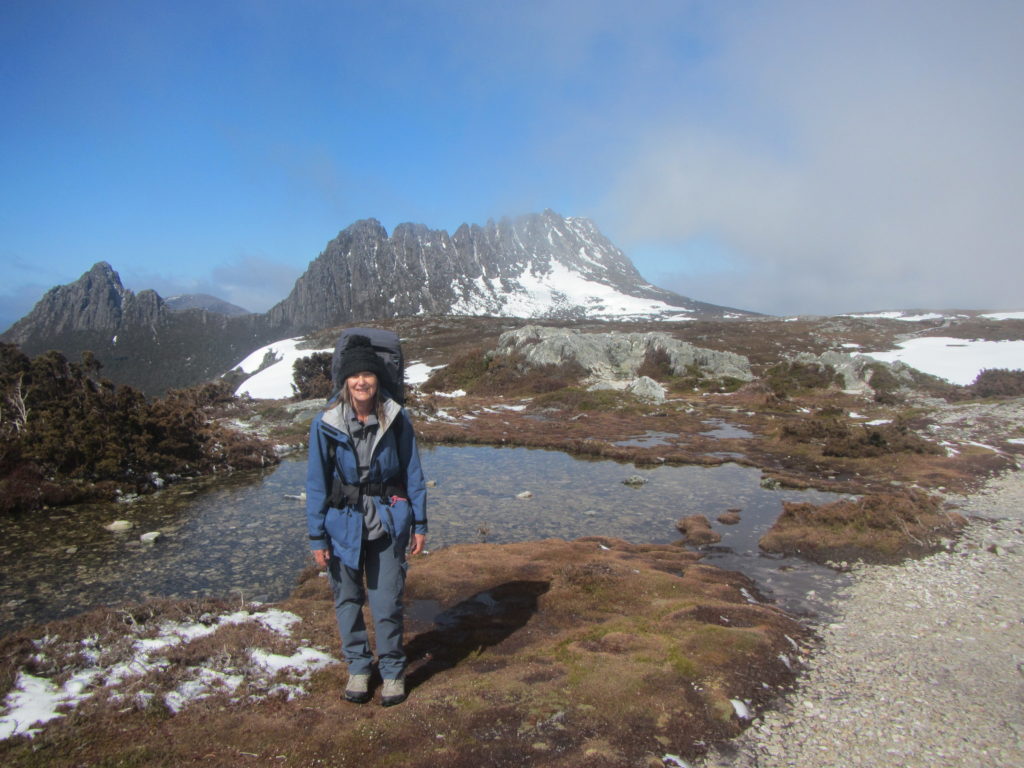
Our first day out was one of those rare blue-sky days. A white carpet covered the high plains. On our approach toward the jagged peaks of Cradle Mountain, we breathed in the fresh mountain air and walked past pools sheeted over with crinkled ice. The mountain landscape was remote and surreal. It was one of those days that justifies the frequent trudges through rain and sleet that often go with hiking.

Post Igloo

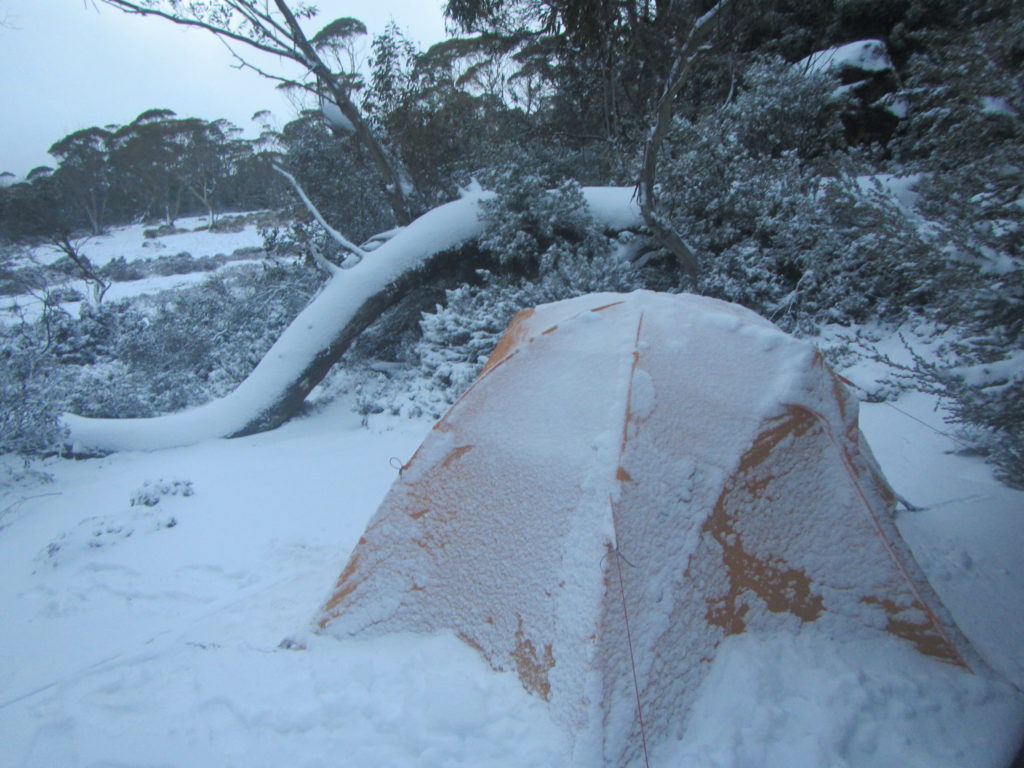
My tent became an igloo that first night. But I’d saved myself from a noisy night in the hiking hut. The rustlings and footsteps – as fellow hikers make nocturnal toilet visits – wake us lighter sleepers up. Further disturbance comes from the regular crinkle of certain brands of sleeping mats whenever their owners roll in their sleep. I was toasty warm in my down expedition sleeping bag purchased years ago from a second-hand shop in Katmandu. My first inkling of the snowfall was when I put my hand out the tent flap to find my jetboil stove to make coffee. The ground surface felt soft. In my early morning stupor, I thought – that’s strange, didn’t I set up camp on a wood platform? Then I registered the cold and realised the platform was inches deep in fresh powder.

I shook most of the snow off my tent and only then remembered to take a photo. The snow continued to fall during my pack-up, definitely preferable to rain but my fingers froze. In the shelter of the forest, it came down soft and light. Later, it blew hard sideways as we hiked across the open plains. We followed the track through the deep snow blazed by yesterday’s hikers. Warm inside our protective clothing, we laughed and joked whenever we were forced to stop to re-find the trail. Everyone fell over, mostly into soft snowdrifts, but nobody was seriously injured. The knowledge of a hut to shelter in up ahead was enough to keep us motivated.

Any time of year, conditions on the Overland Trail can turn severe. We took the risk of a week of bleak weather when we chose to hike in September before the official season opened. This time, luck was with us. The snow blizzard only lasted a day, enough to give us a taste of how severe conditions can be. After that, the sky cleared and a dry, sunny day awaited us every morning. On the last day as we hiked along the edge of Lake St Clair, a massive storm developed in the valley behind us, the thunderclaps reverberating along the lake shores. By the time it broke, we’d arrived at park headquarters and were seated at the bar with our beers already poured.

Filed Under: Hiking, Uncategorized Tagged With: #environment # conservation #elephants #novel #author

  • « Go to Previous Page
  • Page 1
  • Page 2
  • Page 3
  • Page 4
  • Page 5
  • Go to Next Page »

Copyright © 2026 · Author Pro on Genesis Framework · WordPress · Log in